Under the hood.
Technical deep-dives into how note.md indexes PDFs, retrieves passages, and runs local language models — entirely on your Mac.
The local AI architecture behind note.md
How on-device indexing, retrieval, and inference fit together to power semantic search, Matrix extraction, and Evidence Scan — without sending a single byte off your Mac.
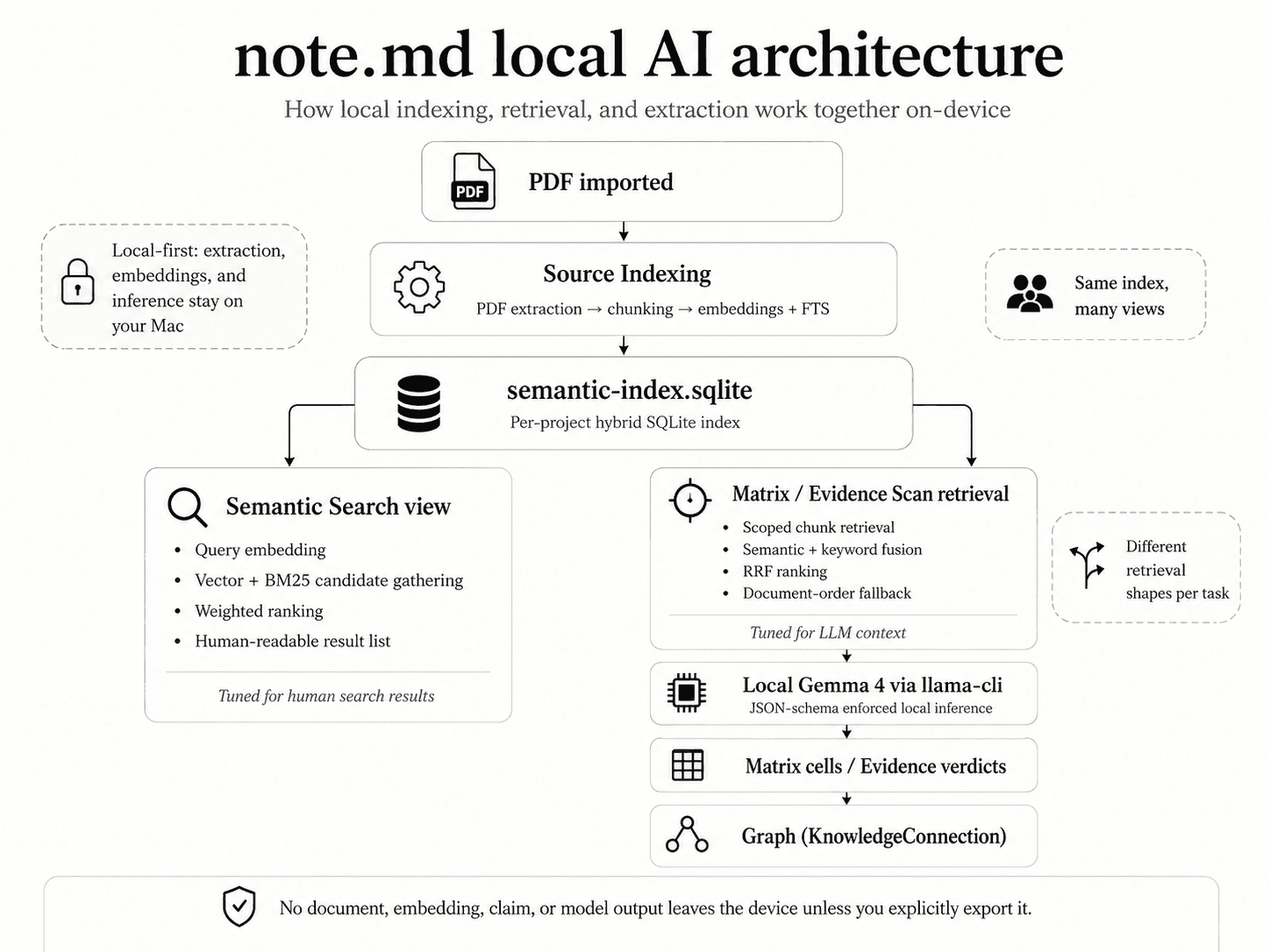
One local index, four pipelines on top of it.
Each pipeline is described step by step, with the chunk sizes, models and ranking math included so you can reason about quality instead of trusting a black box. The last piece steps back and asks the question underneath all of it: what happens to your unpublished work when the AI runs somewhere else.
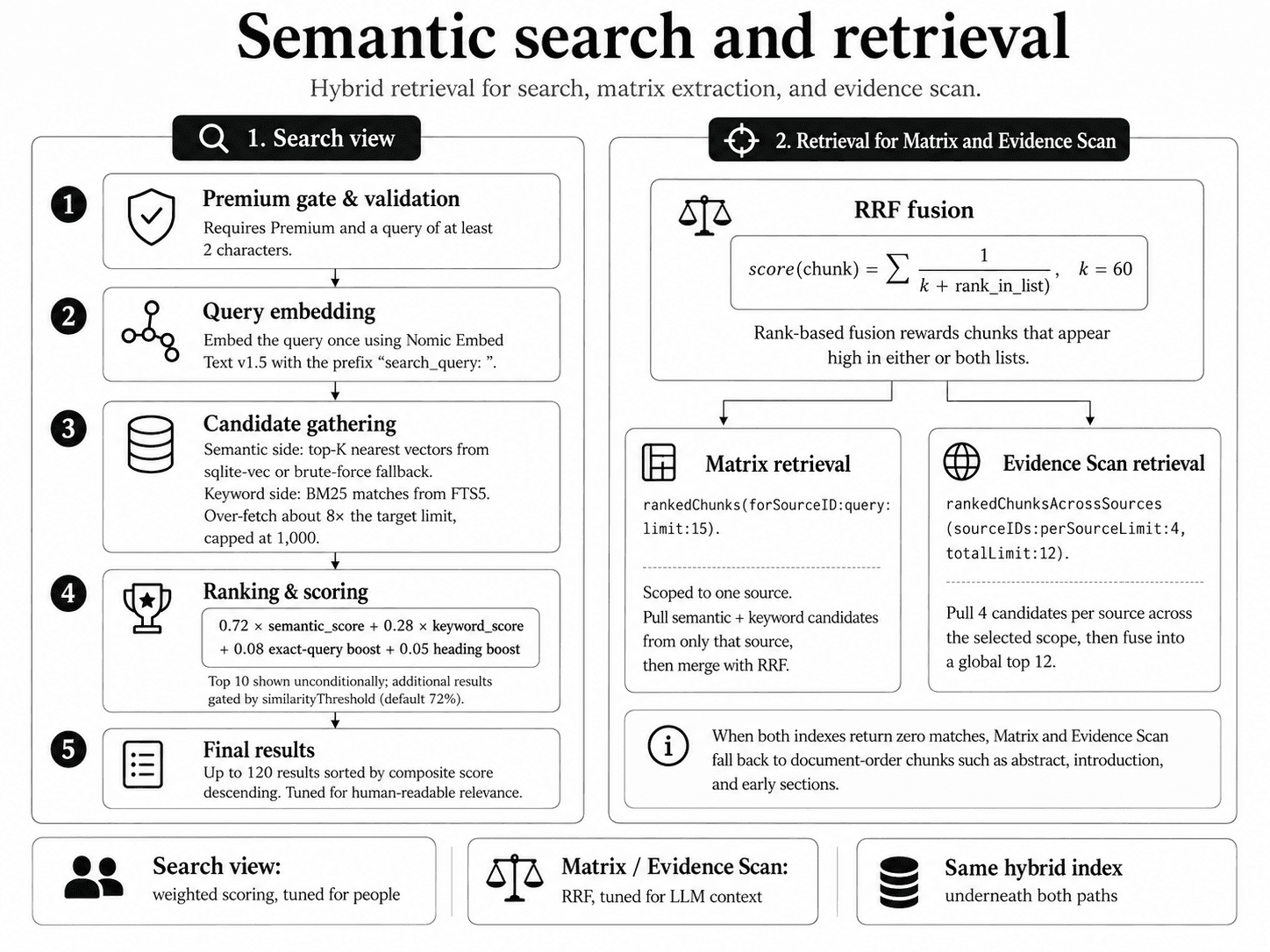
Source indexing: turning PDFs into a local knowledge index
Every imported PDF is extracted, chunked, embedded, and full-text indexed locally. Here is the pipeline that makes search, Matrix, and Evidence Scan possible.
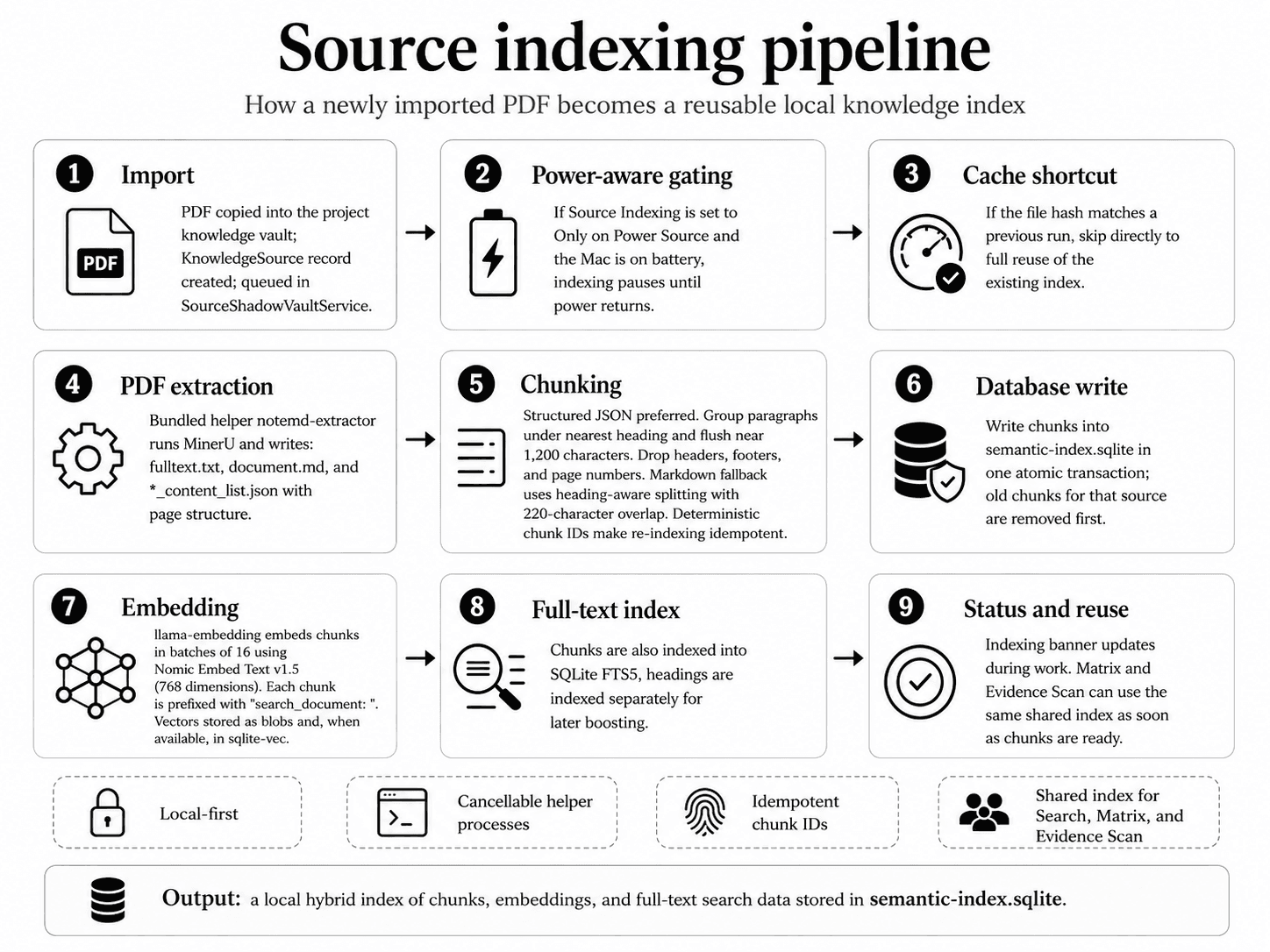
Hybrid semantic search: meaning + keywords, fused
Vector similarity and BM25 keyword matching run side by side, then merge into a single ranked list. The same index, with two different shaping strategies for humans and LLMs.
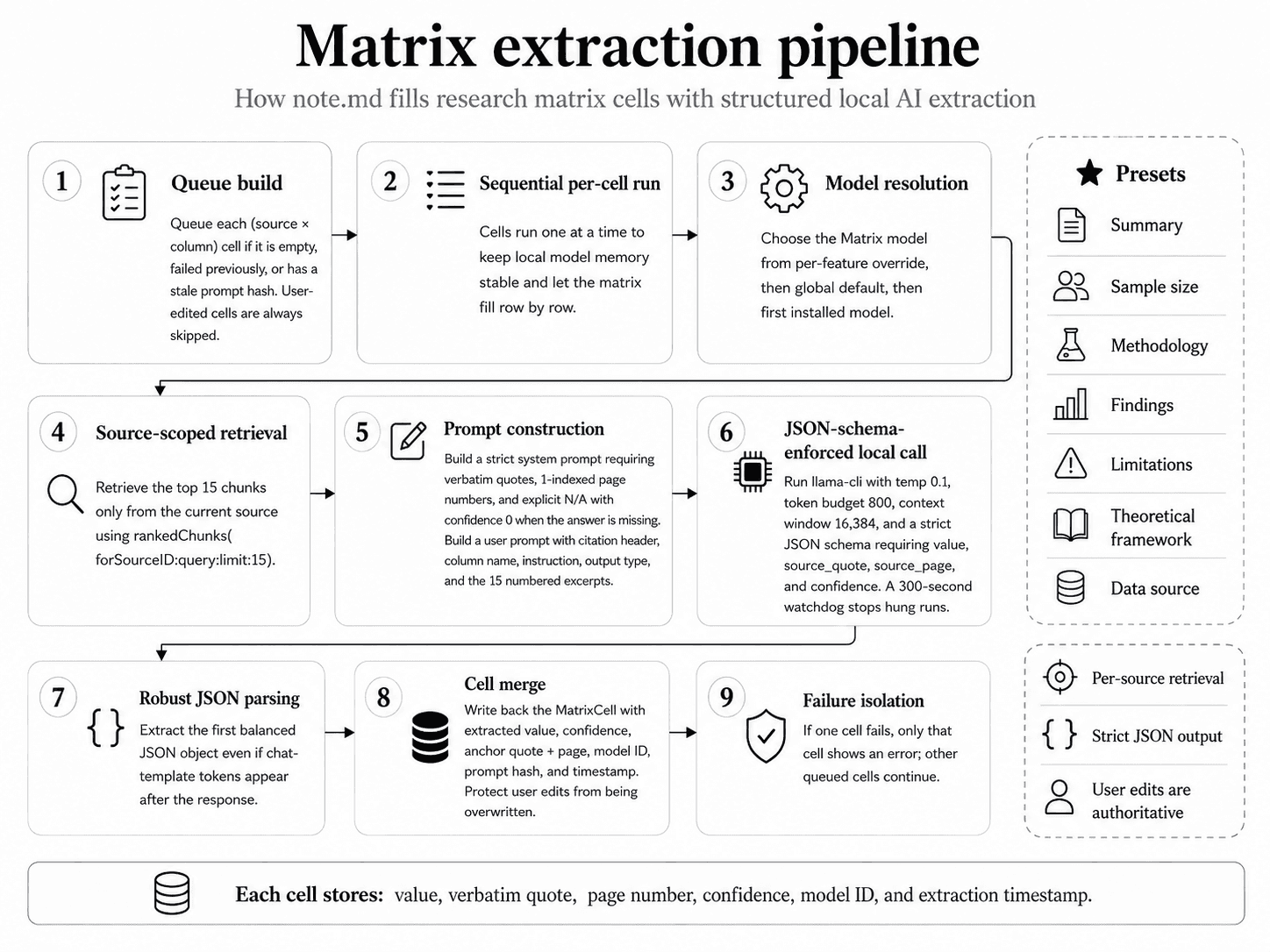
Matrix extraction: filling research tables with local AI
A row-by-row local LLM pipeline that fills research matrices with structured, verifiable extractions — schema-enforced output, per-cell failure isolation, and authoritative user edits.
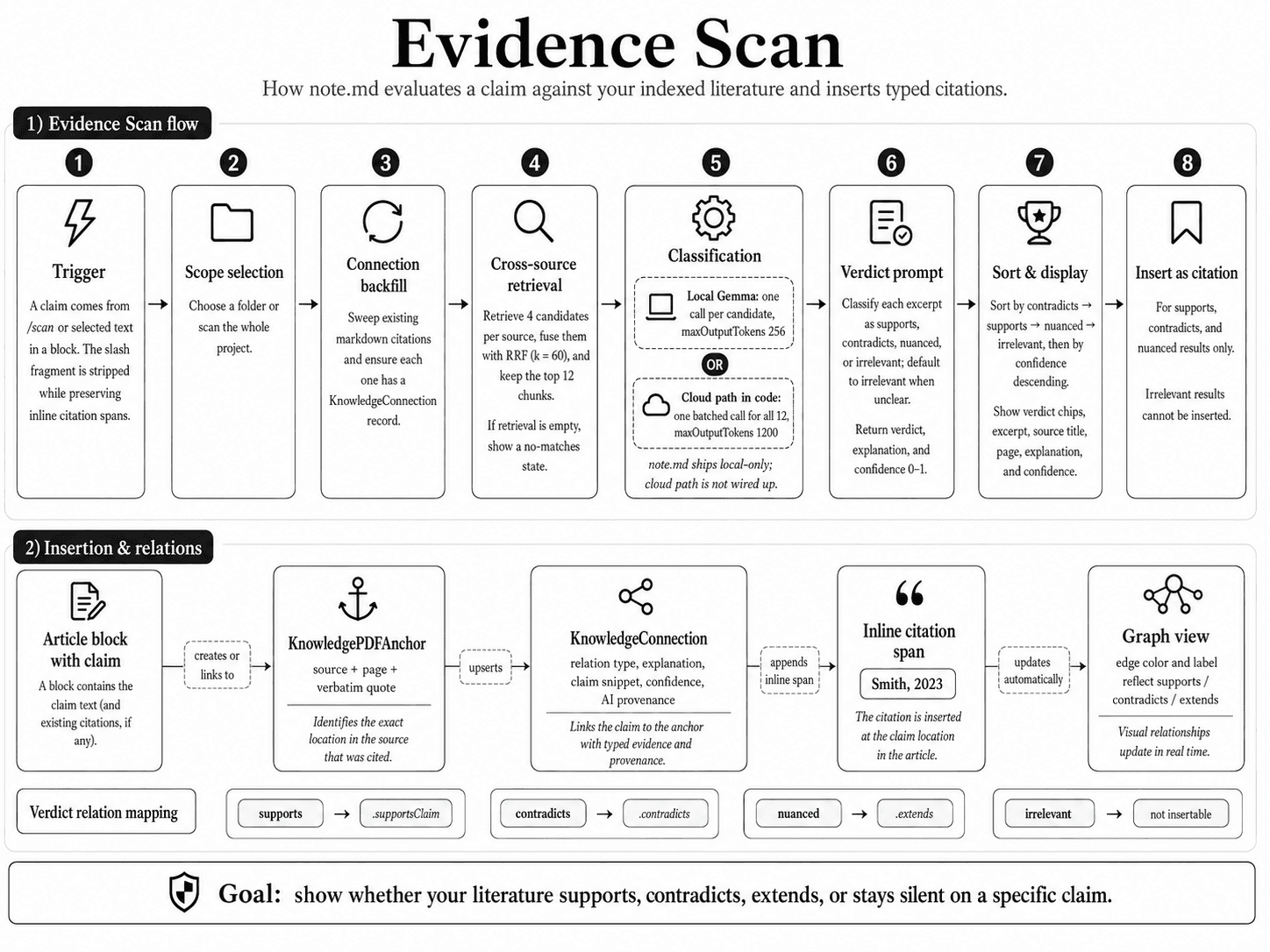
Evidence Scan: finding support and contradictions for any claim
Type /scan on a sentence in your article. note.md evaluates it against your indexed literature and inserts typed citations — supports, contradicts, nuanced, or silent.
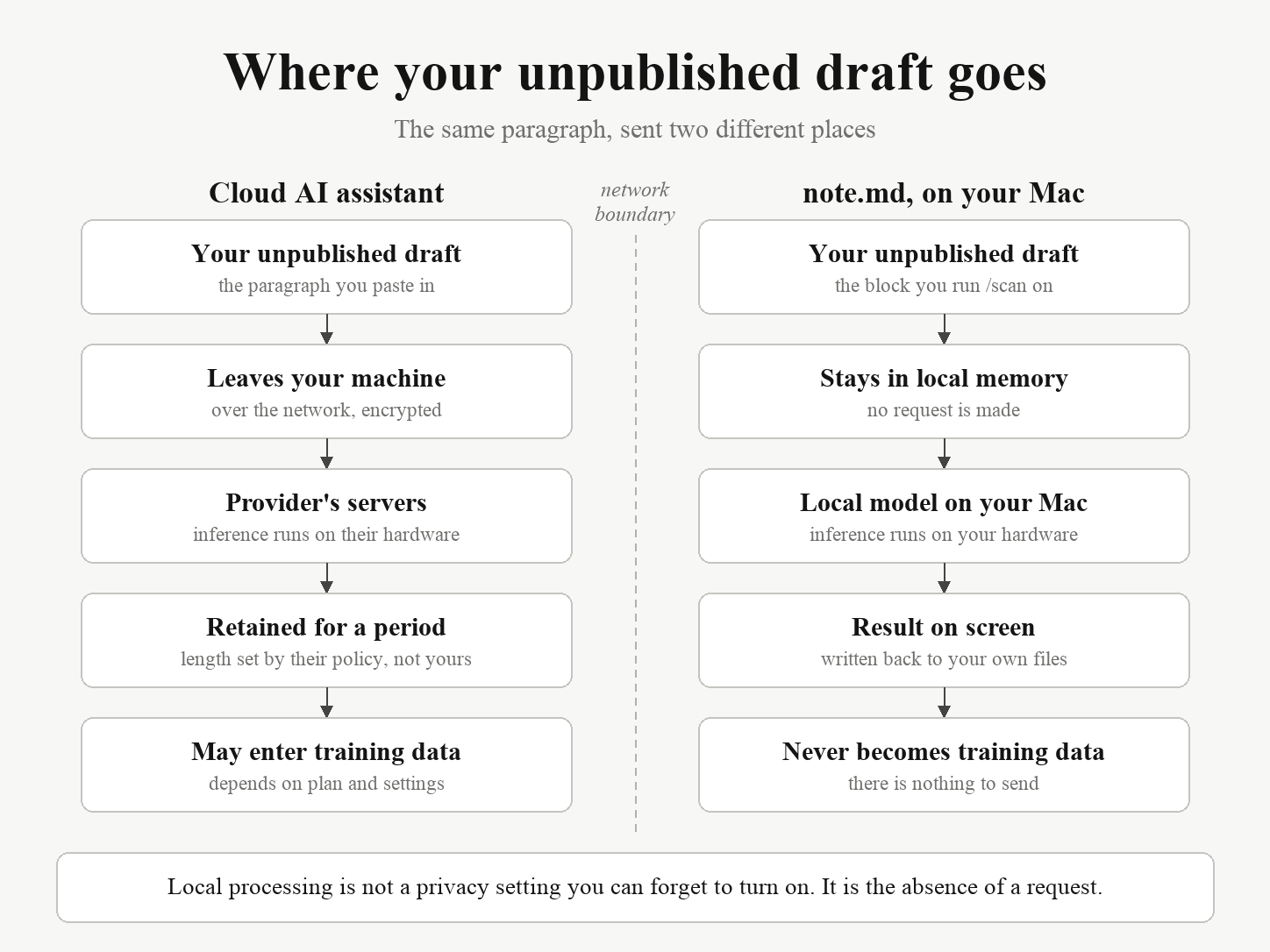
Should you paste unpublished research into ChatGPT?
What actually happens to a paragraph you send to a cloud AI tool, which of the risks are real, what publishers and funders currently say about it, and how to tell whether a tool is genuinely local.
Local. Private. Yours.
No document, embedding, claim, or model output leaves your Mac. Download note.md and run the pipelines yourself.
 Free on the App Store